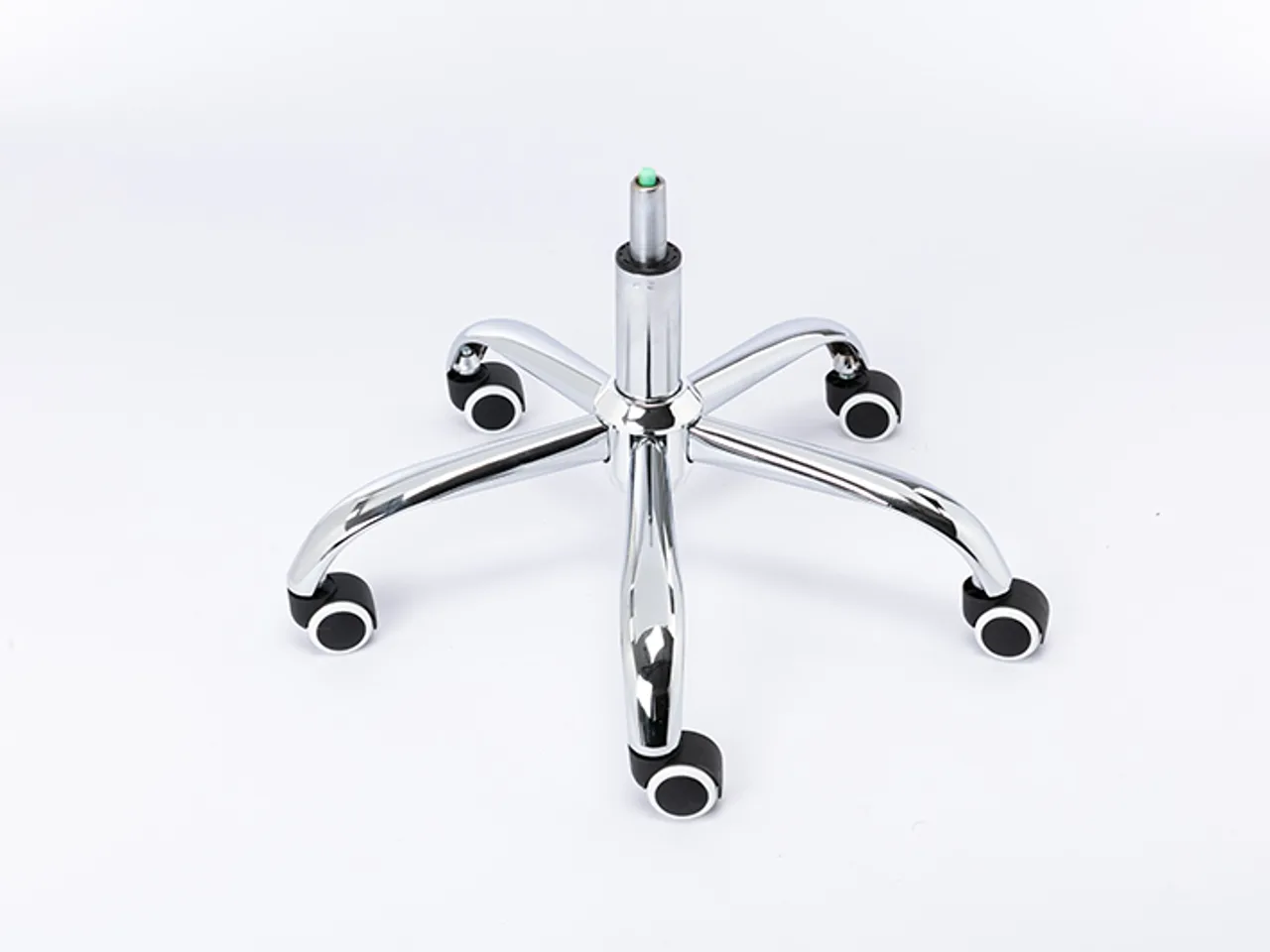
The whole promise of a knock-down taper foot is that it presses together by hand in about 20 seconds and then locks tighter the harder you sit on it. That promise lives or dies on tolerance. The same joint, machined two hundredths of a millimetre off, is either a wobble or a part your assembly line cannot push home. This is the unglamorous engineering that separates a taper foot that works from one that just looks like one.
Why the window is so narrow
A self-locking taper holds by wedging — the two cone faces jam together with enough friction that load cannot push them apart. How hard it locks depends on two things: the contact surface area between the sleeve and the tube, and how closely the two taper angles match. If the angles disagree even slightly, the cones touch on a line instead of a face, the contact area collapses, and the joint that should grip just rocks. The locking condition itself is a friction-and-geometry equation — a taper locks roughly when its half-angle is at or below the arctangent of the friction coefficient. Translate that out of the textbook and it means the fit has to be controlled tightly, every part, or the physics stops working.
The hand-press versus self-lock balance
Here is the tension we design around. The fit has to be loose enough that a worker can seat the arms into the hub by hand, with a firm push, in seconds — no press, no heat, no mallet. But it has to be tight enough that under a seated load the taper wedges and stays. Those two demands pull in opposite directions, and the band that satisfies both is only a few hundredths of a millimetre wide on the bore and the tube. We hold that band with controlled machining and a go/no-go check on the mating diameters, not by eyeballing it. A foot that presses too easily is a foot that will work loose in the field; a foot you have to hammer is one your line will reject.
How we actually hold it on the line
A tolerance you cannot measure is a tolerance you do not have. We do not check the taper fit by feel; the mating diameters get a go/no-go check so a part that drifts outside the band is caught before it is packed, not after it reaches your floor. The point of a go/no-go gauge is that it does not need a skilled reader — it either passes or it does not — which is what keeps a tolerance honest across a full production run rather than just on the first-article sample everyone inspects carefully. The cost of that gauging is real, and it is part of why a taper foot is not as cheap as a drilled-and-bolted one. It is also exactly the cost a buyer is paying us to absorb instead of discovering in the field.
Temperature is the variable people forget. Metal expands and contracts with heat, and a press fit that is perfect at 25 degrees in our shop behaves slightly differently in a freezing winter warehouse or a hot container crossing the equator. The effect is small on a part this size, but on a fit measured in hundredths of a millimetre, small is not zero. We design the band with a little tolerance for that swing so the foot still presses by hand in cold receiving and still locks tight in service — rather than tuning it to lock perfectly only at one temperature.
Material and surface matter as much as the number
The tolerance number is not the whole story, because friction is part of the equation. Surface finish on the cone, the hardness of the two parts, and the coating all change how the same dimensional fit behaves. A polished bore and a rough one at the identical diameter do not lock the same way. That is why we treat the finish decision as connected to the fit, not separate from it — a coating that adds film thickness to the taper face changes the press, and we account for it before we cut metal.
The trade-off, honestly
Holding this tolerance costs more than drilling a hole for a bolt. That is the real reason a bolted leg is cheaper to make. What you buy back for the extra machining is a joint with nothing to loosen, no screw kit, and a part that ships flat. For high-duty seating that is a good trade; for a low-use stool it may not be, and we will tell you which you have.
How we prove the fit on your order
The nested taper foot is our own design, developed in late 2020 with patents filed in early 2021, and the fit discipline above is exactly what those patents are about. We confirm the exact taper, tube and tolerance against your drawing before tooling, and load and durability testing — built to BIFMA/EN methods — can be arranged per order. If you are evaluating certification claims from any chair component supplier, the verifying certification claims guide at ChairManufacturer.net explains what documentation to ask for and how to read it. Talk to someone who machines these through our contact form, read more on the design story, or email [email protected].