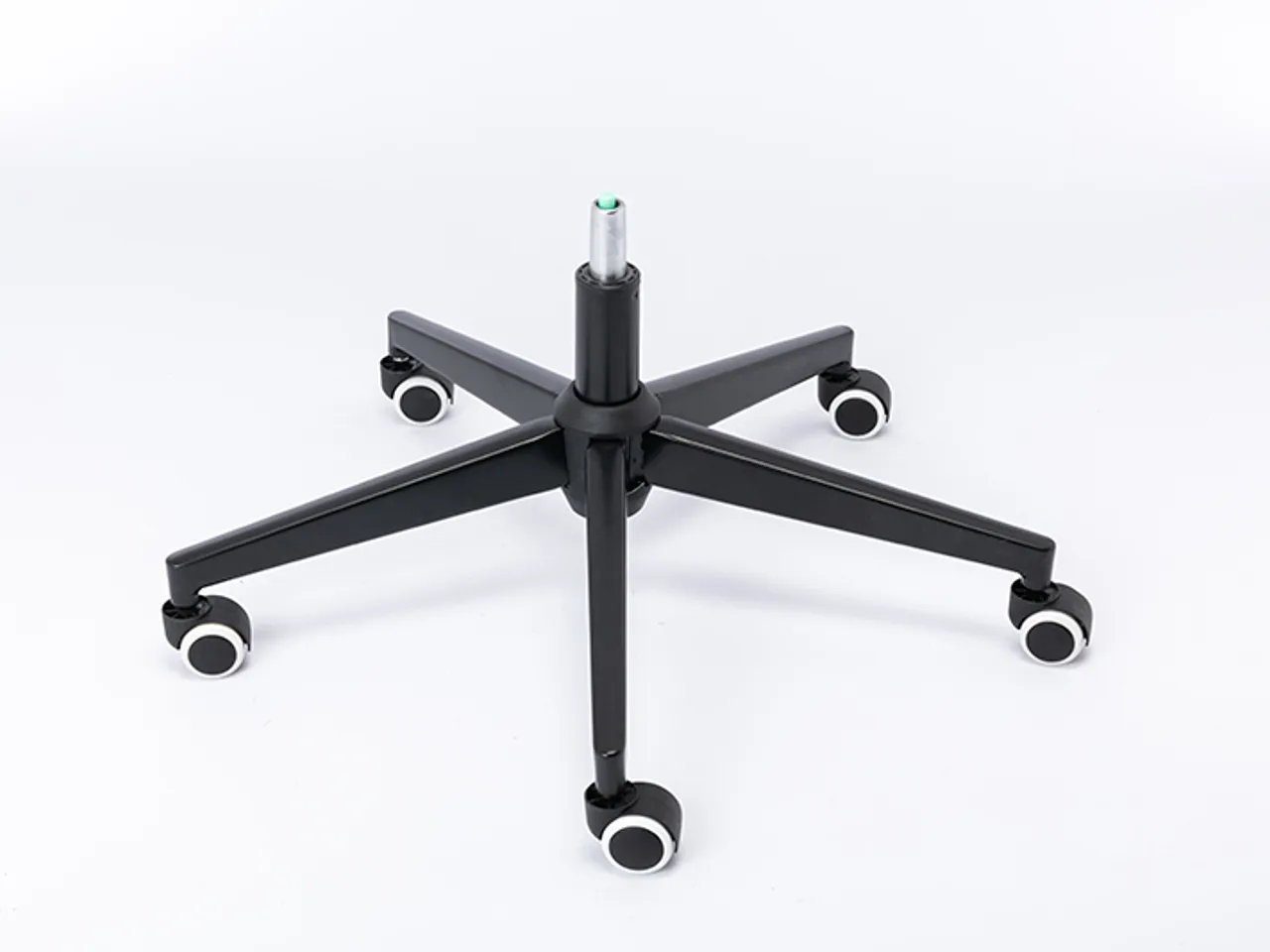
We have written before about why a taper joint holds where a bolt backs out — the joint physics piece covers that. This note is about the question factories actually ask us once they are convinced: what changes on my line if I switch a running SKU from bolted legs to taper-lock feet? The answer is more than people expect, and not all of it is good news, so here it is station by station.
What disappears from the station
Start with the tools. A bolted five-leg base is typically four to six fasteners per chair, each one driven by a powered driver that has to be torque-controlled. That driver is not just a tool — it is a small process. It needs a torque setting per joint, a calibration schedule, and somebody auditing that the setting has not drifted, because an under-torqued bolt is a warranty claim and an over-torqued one is a cracked boss. On a taper line all of that goes away. There is no driver, no bit wear, no torque audit and no air line to that station. The press motion needs a firm push and a flat surface, and that is the whole tooling list.
The consumables go with it. No bolts, no washers, no thread-locker, and no bin of each at the station that somebody has to keep stocked and somebody else has to count at month end. Fastener hardware is cheap per piece and surprisingly expensive per year once you add the purchasing lines, the stock-outs and the floor spillage. Deleting four part numbers from a BOM is an unglamorous saving that your materials planner will notice before your accountant does.
What the station does instead
The taper station is a simpler motion: orient the arm, present it to the hub, push until it seats. Our nested knock-down foot is designed to seat by hand in about 20 seconds for the full set, with no mallet and no fixture beyond a bench. The skill is not strength, it is recognition — a worker has to know what fully seated looks and feels like, because a half-seated taper is the one failure mode this design allows. We supply a seating-depth mark on request for exactly this reason: a visual go line beats a feel-based judgement on hour eight of a shift.
Takt-wise, most lines come out ahead. Driving five bolts with handling and verification rarely beats a five-press sequence, and the taper station has no fastener-feed jams to clear. But do not bank the gain until you have run a pilot — layouts differ, and a line that was buffering on upholstery anyway will not get faster chairs out the door just because the base got quicker.
The carton changes more than the chair does
If your chair ships knock-down to the end customer, the switch reaches into the carton. The hardware bag goes — no screw kit, no Allen key, no little sachet that is the single most common missing-part complaint in flat-pack furniture. The instruction sheet drops from a numbered fastener diagram to one drawing: push until seated. Customer-service tickets about stripped threads and lost bolts disappear because the failure is no longer possible. For an e-commerce SKU where every return hurts twice, this is frequently the strongest argument for the whole conversion, ahead of the joint itself. The flat-nesting pack also cubes tighter, which our freight note puts numbers on.
What gets harder, honestly
Three things, and we would rather you hear them from us. First, rework runs the other way. A wrongly bolted leg unbolts; a fully seated taper is designed not to come apart, so a part pressed in the wrong orientation is a scrapped joint, not a five-minute fix. The discipline has to move upstream, into orientation checks before the press — which is why we mould orientation keys into parts where the design allows it.
Second, your incoming inspection changes character. With bolts, a slightly off part still assembles and the bolt hides the variance. With a taper, the fit is the function, so the parts you receive have to be the parts that were quoted — we hold that band with gauging at our end, and the tolerance note explains how. What lands on you is simpler but non-negotiable: keep the cones clean. A taper pressed over grit or a paint blob behaves like a bad part even when it is a good one.
Third, field service. A bolted chair can be re-tightened by a facilities person with a hex key; a taper chair never needs that, but when an arm is damaged the repair is replace, not adjust. Stock a few spare arms per hundred chairs and the maths still favours the taper — just do not promise your dealer a “re-tightenable” product, because that is the one thing this joint refuses to be.
How to run the switch without betting the line
Our standard advice: convert one SKU, not the catalogue. Run a pilot batch of a few hundred on the taper foot while the bolted version stays live, time the station honestly, and let your own QC compare the first month of field data. We confirm the fit against your actual tube and column before tooling, and load testing to BIFMA and EN methods can be arranged per order so the converted SKU re-enters your range with a fresh report rather than an assumption. Send us the drawing of the bolted base you run today through our contact form, read how drawing-built parts work, or email [email protected].