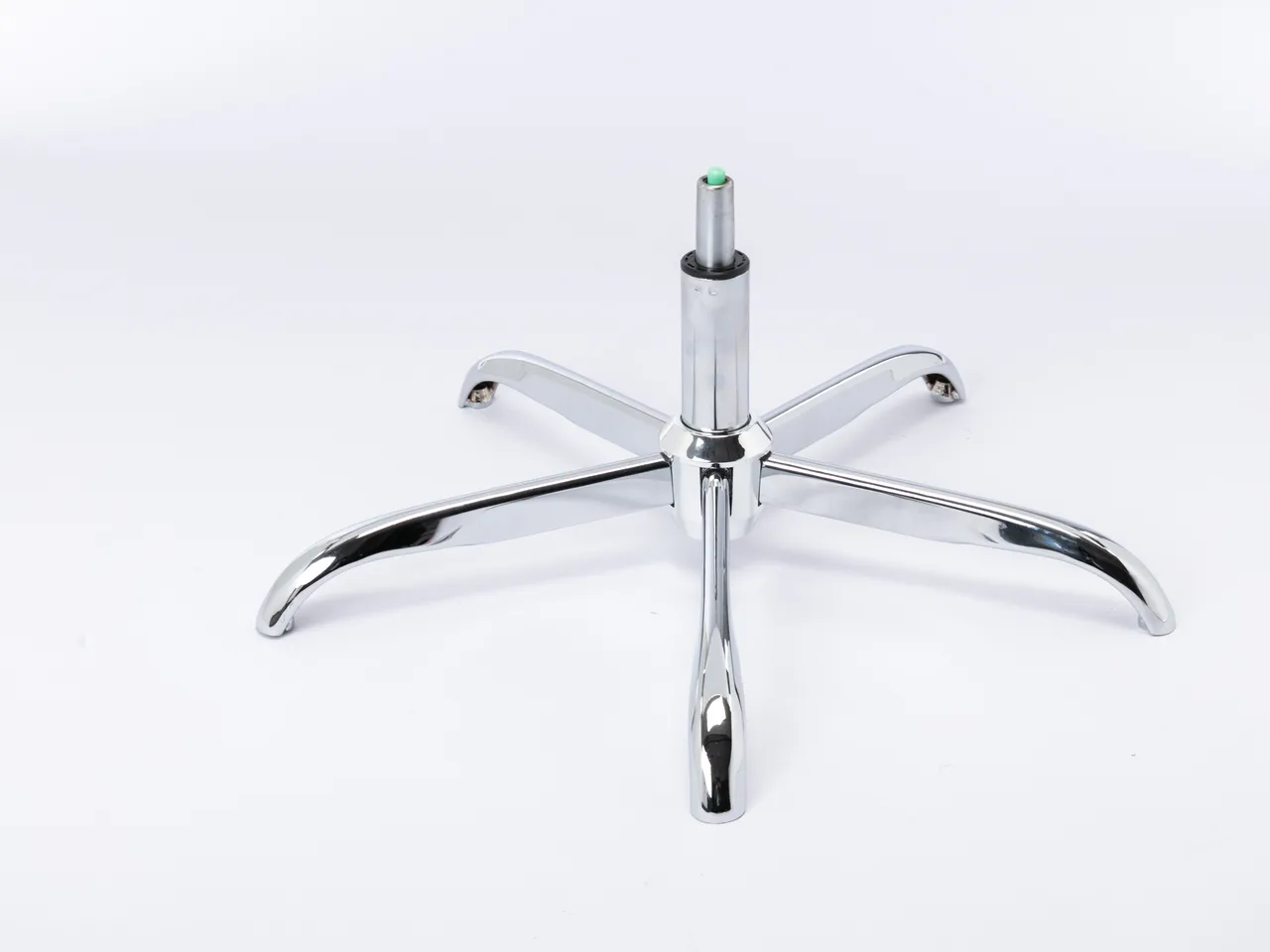
Every chair foot has to solve one problem: keep the column and the arms rigid for years while a person rocks, swivels and shifts weight on it thousands of times a day. There are two ways to do that. You bolt the parts together, or you press them into a taper and let the geometry hold. We build the second kind, so treat what follows as a biased but honest comparison — we will tell you where a bolted leg is the better buy.
The case against the bolt is not the bolt, it is vibration
A bolted leg is fine on day one. The problem is what engineers call self-loosening: under repeated vibration, impact and alternating load, a threaded fastener tends to rotate loose on its own. That is not a quality complaint about cheap bolts — it is documented behaviour of threaded joints, the reason aircraft and machine builders spend real money on thread-lockers, nylocks and safety wire. A chair is a low-stakes version of the same physics. The foot gets a small impact every time someone drops into the seat, and a thousand small impacts add up to a quarter-turn of play. Play is what the end user feels as a wobble, and a wobble is what comes back as a warranty claim.
There is a second cost to the bolt that buyers forget: the bolt is a part too. Every threaded leg needs the fastener, often a washer, sometimes a thread-locking compound, and a person or a machine to torque it to spec. Under-torque and it loosens early; over-torque and you strip the boss or crack a casting. We have opened return samples where the leg was sound and the only fault was a bolt run in dry, off-axis, to the wrong torque on a Friday line. None of that is in the unit price you compared on the quote, but all of it is in your assembly time and your reject rate.
Why a taper does the opposite
A self-locking taper behaves backwards from a bolt: load makes it tighter, not looser. The rule of thumb from the machine-tool world is that a taper shallower than about 3 degrees is self-holding — the friction on the cone face exceeds the force trying to push it back out, so it wedges. Standard industrial taper-lock bushings use roughly a 1:12 ratio, about 4.76 degrees included angle, and once they are driven home they hold without relying on the fastener alone. Our nested chair foot borrows the same idea: a sleeve over a tapered foot tube. Push it home and it wedges; sit on the chair and the wedge tightens. We describe it on the shop floor as 越受力越牢固 — the more it is loaded, the more firmly it locks.
The practical payoff is that there is no fastener to back out, no screw kit in the carton, and nothing for an end user to strip. The part also nests flat for shipping, which is a separate win we cover in our piece on knock-down feet and flat-pack freight.
It also changes how the chair feels under a person. A bolted joint has a tiny clearance designed in — the bolt has to pass through the hole, so the hole is bigger than the bolt. That clearance is where the first millimetre of wobble lives, even on a brand-new chair. A pressed taper has no clearance by definition: the two faces are in continuous contact around the whole cone, so the joint is rigid from the first sit, not after it has been re-tightened once in the field. For a swivel chair that gets leaned back in, that difference is the gap between "solid" and "creaky" in a showroom test.
What the test rig says
None of this is a reason to skip testing — it is a reason to test the right thing. The BIFMA X5.1 sequence for an office chair puts the base through a static load test, a dynamic drop test and a swivel cycle test that runs to 120,000 cycles. A bolted joint and a taper joint can both pass that on a fresh sample; the question the test does not fully answer is what happens at cycle 200,000 in a real building, and that is where the self-loosening behaviour of the bolt shows up and the taper does not. So we build the foot to clear the standard, and we design the joint to age past it. Testing to BIFMA or EN can be arranged per order — we will say more on that below.
The trade-off, stated plainly
A taper is not free. To self-lock reliably it needs a controlled fit between the sleeve bore and the tapered tube — get the tolerance wrong and the joint is either loose or impossible to press by hand. That means tighter machining and tighter QC than drilling a hole and running a bolt. We go into the actual numbers in our note on press-fit tolerance on taper joints. So if you are building a flat, knock-it-together stool that ships with an Allen key and lives a quiet life, a bolted leg is cheaper to make and perfectly adequate — do not let us oversell you a casting. Where the taper earns its keep is seating that gets hard, repetitive use: task chairs, bar stools, anything that rocks or swivels for hours.
How we spec it on your order
We build our feet and legs to BIFMA and EN test methods, and load and durability testing can be arranged per order through a third-party lab — we do not pre-print a certificate that may not match your final tube and finish. What we will do is tell you, against your drawing, whether your chair is a taper job or a bolt job, and quote both honestly. Send a sample of the foot you use now and the duty cycle you expect, and we will come back with a real recommendation.
Want to talk it through with a person who machines these for a living? Reach us through our contact form, read how private-label and drawing-built parts work, or email [email protected].