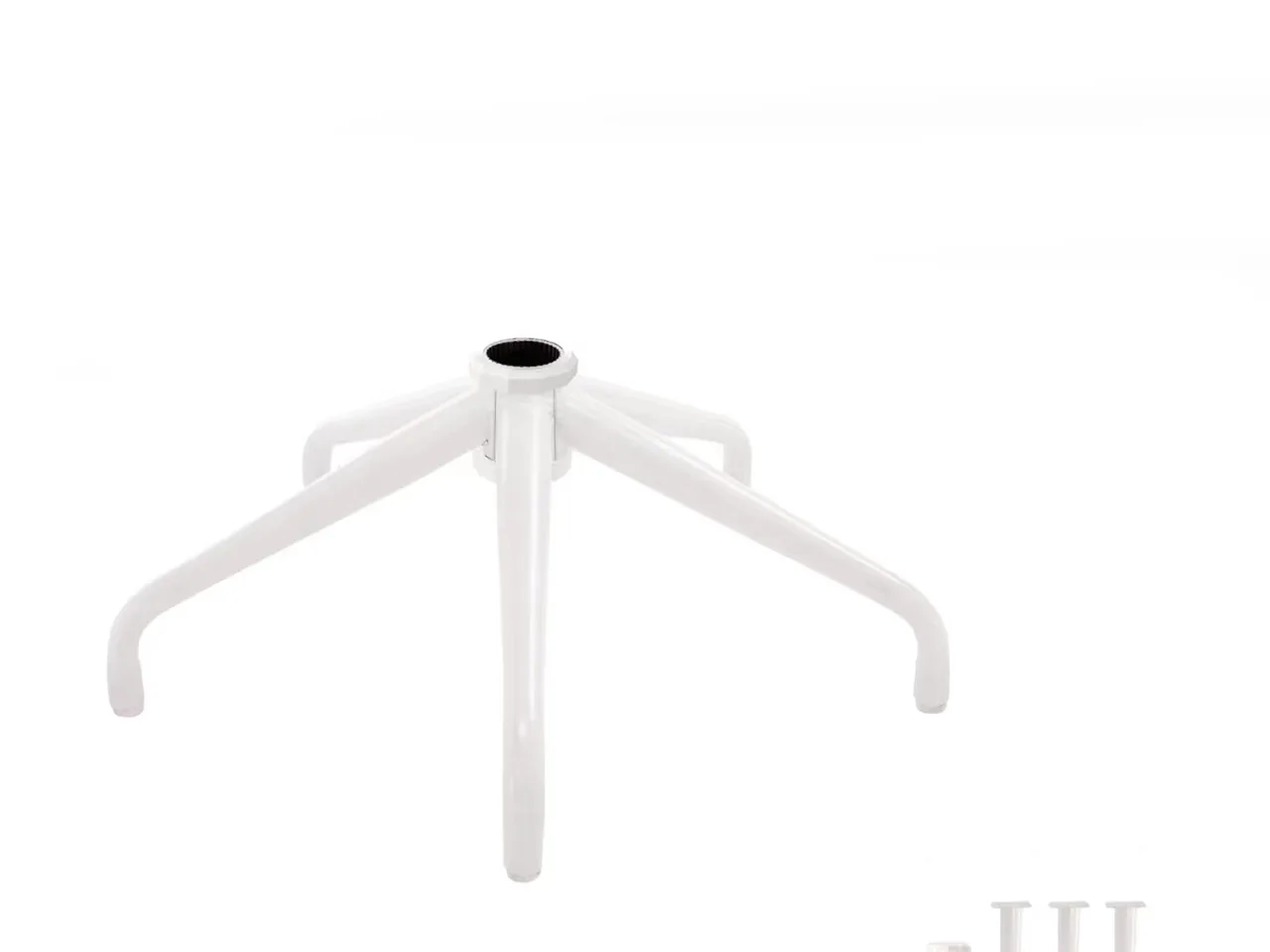
Freight is the cost line most chair factories under-think when they buy components. The unit price of a welded five-star foot looks fine on the quote. Then it ships as a fixed, splayed shape that traps air around it in the carton, and you pay ocean freight on that air for every container, on every order, forever. A knock-down foot fixes that by shipping the parts nested and pressing them together at your end.
What "knock-down" actually buys you
Knock-down (KD), or flat-pack, is not a new idea — it is the whole reason IKEA's supply chain works. Industry write-ups on flat-pack design put the volume reduction at 50–75% versus assembled goods, and a furniture-import guide we trust pegs the practical range at 40–60% space savings for goods shipped knock-down from China. Our own feet sit at the conservative end of that: nesting the hub and arms instead of shipping a welded spider cuts pack volume by roughly 30%, and trims material cost by about 12% because there is no welded jig waste. We quote the 30% because we would rather under-promise on the carton and have you measure it yourself.
Run the container math once and it sticks
A 40HQ holds about 68 cubic metres of usable space, and on most chair-component loads you cube out long before you weigh out — you run out of room before you run out of payload. So if KD packing takes 30% of the volume off each foot, you are not saving 30% on freight in the abstract; you are fitting close to a third more feet in the same box you already paid for. On a component that ships by the tens of thousands, that is a freight saving that lands on the buyer's landed-cost sheet without touching the unit price. Flat-pack is now roughly 47% of furniture logistics for exactly this reason.
Put rough numbers on it. Say a welded five-star foot cubes out at a count that fills a 40HQ at 10,000 pieces. Take 30% of the pack volume off and the same container now carries on the order of 14,000 pieces. If your all-in ocean and handling cost on that box is, for argument's sake, the same either way, your freight-per-foot just dropped by close to a third. Run that across a year of containers and it is not a rounding error — it is the kind of saving that decides whether your landed cost beats the factory down the road. We do not promise a specific container count because it depends on your carton and your foot size, but the direction is always the same and it is always in your favour. For a thorough overview of how to pack and load chair components efficiently, the container loading guide at ChairManufacturer.net is a useful reference point.
There is a quieter benefit too: nested parts are less likely to arrive damaged. A welded spider has five arms sticking out at angles, and those arms are exactly what gets bent when a carton is dropped or a forklift catches an edge. Hub-and-arms packed flat present no protruding geometry to damage, so the in-transit reject rate on KD shipments tends to be lower. Fewer DOA parts is freight you do not pay twice.
The trade-off: a little labour moves to your floor
Here is the honest catch. Knock-down moves the final assembly step from our shop to yours. Our foot is designed to hand-press in about 20 seconds with no tools and no screws — that is the point of the nested taper-lock design — but it is still a step your line has to do. If your factory is set up for sub-assembly, that 20 seconds is nothing against the freight you save. If you are a small shop running thin on labour and shipping short distances by truck, a pre-welded tube spider leg may net out cheaper once you count the handling. We will tell you which side of that line your order falls on.
One more thing the KD route changes is your own warehouse. Flat parts stack and store at a fraction of the footprint of assembled spiders, so if you carry buffer stock of feet between orders, knock-down quietly buys back shelf space as well as container space. For a factory that is tight on floor area — and most are — that is a real second saving on top of freight.
How we pack it for you
We pack to your carton spec, nest to your count per box, and can mark cartons to your SKU. If freight is the thing you are trying to fix, send us your destination port and rough monthly volume and we will work the cube both ways — KD versus welded — so you are comparing landed cost, not just the line on the quote. The taper-lock design is what makes the hand-assembly fast enough to be worth it; if you want the joint detail, read our note on taper versus bolted joints. Standards note: we build to BIFMA/EN methods and testing can be arranged per order.
Get the comparison done properly through our enquiry form, see the full catalogue, or email the desk at [email protected].