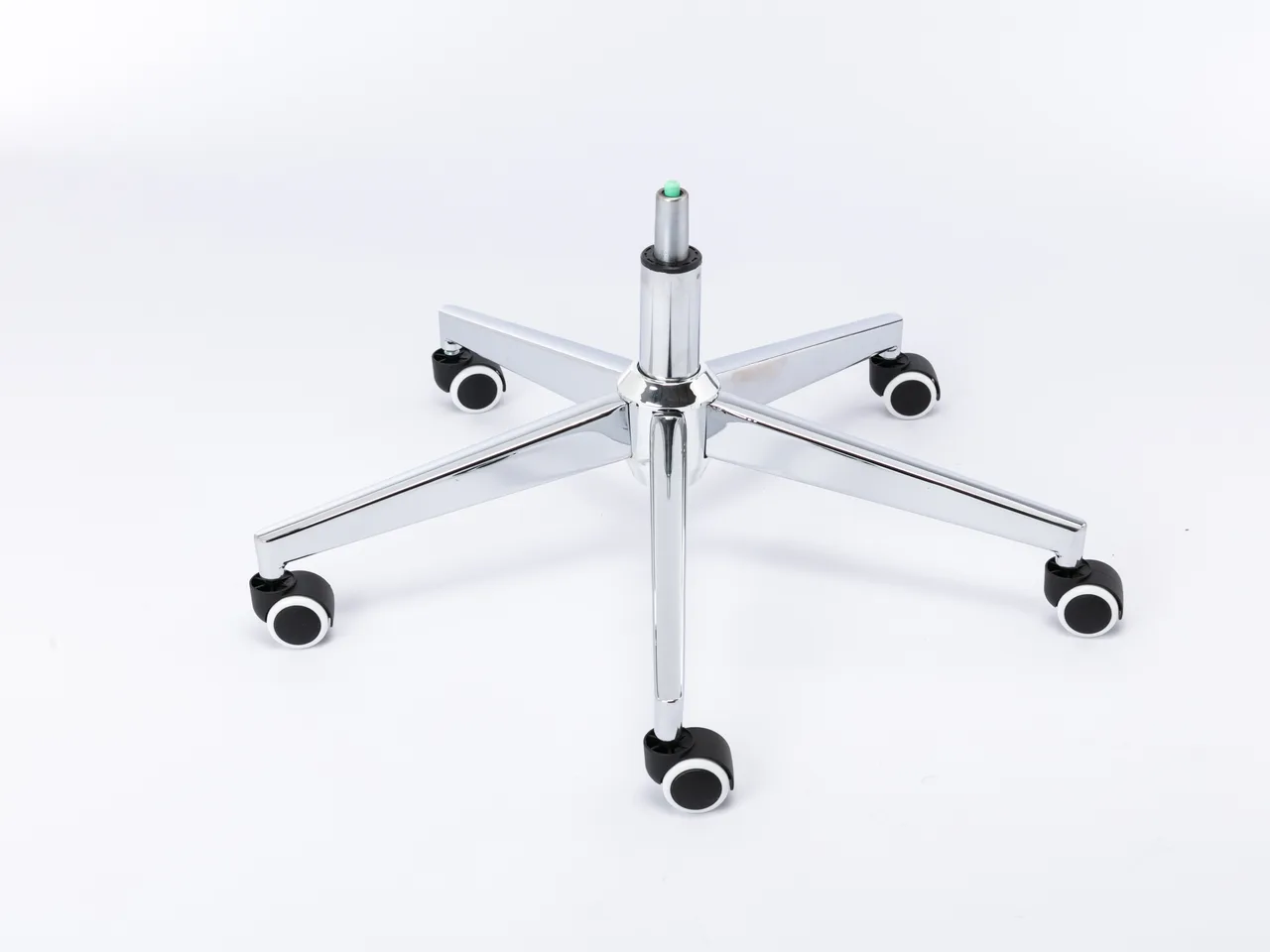
The bottom of a chair leg is the cheapest part on the whole assembly and the one most likely to generate a complaint. A tube end that cracks, a caster that scratches oak, a glide that grips so hard the chair tips — all of those are floor-contact problems, and all of them are decided at the drawing stage for a few cents. Here is how we spec the part that touches the ground so you are not solving it in the returns queue.
Glide or caster: start with whether the chair moves
A glide is a fixed foot; a caster rolls. The first question is not the floor, it is the use: a chair that stays put wants a glide, a chair that gets dragged or rolled wants a caster. Casters also flip the floor logic in a way people get wrong. Hard casters actually roll better on carpet, where a soft wheel sinks and drags; soft PU or rubber-coated casters are the ones you want on hard flooring like wood or tile. Spec a hard nylon caster for a showroom with oak floors and you will hear about it.
Matching glide material to floor
For fixed glides the material is the whole decision:
- Felt — gentlest on hardwood and laminate, quiet, but wears and collects grit; better for light, indoor, slow-moving chairs.
- Nylon / plastic — the all-rounder. Strong, durable and works on almost any floor; the safe default when you do not know the end user's floor.
- Rubber / PU — protects wood and tile, runs quiet and grips well, which is good for stability but means it can drag and can trap grit that then scratches. Excellent for stools and chairs that should stay put.
The trap with rubber is that the same grip that stops a stool sliding is what picks up a stone and turns the glide itself into sandpaper. For a busy entrance or a workshop, nylon's lower grip is often the safer call even though rubber "protects floors better" on paper.
The caster stem is a fit problem too
If the chair rolls, the caster plugs into the base by a stem — usually a grip-ring stem that snaps into a socket, or a threaded stem. The stem diameter and the socket bore have to match, and this is where mixed-source ordering goes wrong: a base from one supplier and casters from another that "look the same" can be a millimetre off on the stem, and a millimetre is the difference between a caster that clicks home and one that falls out under a leaning user. When we supply a five-star foot or a spider leg drilled for casters, we cut the socket to the stem you are using, not to a generic nominal, so the snap is firm. If you are sourcing casters separately, send us the stem diameter and we match the bore to it.
For seating that should not roll away on a slope — a salon chair, a stool at a high counter — there are also braked and load-locking casters that hold still until weight comes off the seat. They cost more and they are heavier, so we only spec them where the use actually needs them. A general task chair does not, and paying for braked casters there is money the end user never feels.
Do not forget the tube end itself
On a tube leg, the glide presses into the open end of the tube, so the tube end and the glide are one system. If the insert diameter and the tube ID do not match within tolerance, the glide either falls out in service or splits the tube on the press. We size the insert to your actual tube wall, not the nominal size, because a 1 mm wall and a 1.5 mm wall on the same 22 mm tube take different inserts. That fit discipline is the same thinking behind our press-fit taper joints.
An open tube end with no insert is the cheapest possible "finish" and it is a recall waiting to happen: the raw steel edge scratches every floor it touches and can cut a careless hand. A proper plastic or felt-faced glide insert costs a few cents and closes that risk completely. We treat the glide as mandatory on any tube leg, not an upsell, because the few cents you save by leaving the tube open come back as floor-damage complaints that dwarf the part cost.
How we spec the floor contact on your order
Tell us the destination — a US contract market with carpet tile is a different glide from a European showroom with engineered oak — and we match the foot, glide or caster to it. We build feet and legs to BIFMA/EN methods, including the caster and base durability side, and testing can be arranged per order. Send your tube spec and floor target through our contact form, browse the catalogue, or write to [email protected].